
Singapore Math
Problem-Solving Skills
Bar model method, heuristics, and structured word problem strategies for international school students. Develop mathematical rigour your school curriculum may not teach. Max 5 students per class.
Why International School Students Come to MathArchery for Singapore Math
Singapore has consistently ranked at or near the top in international mathematics assessments (TIMSS, PISA, and others) for over two decades. The reason is not that Singapore students are naturally more gifted. It is that the Singapore curriculum teaches mathematics with a specific, structured approach to problem-solving that other curricula do not replicate.
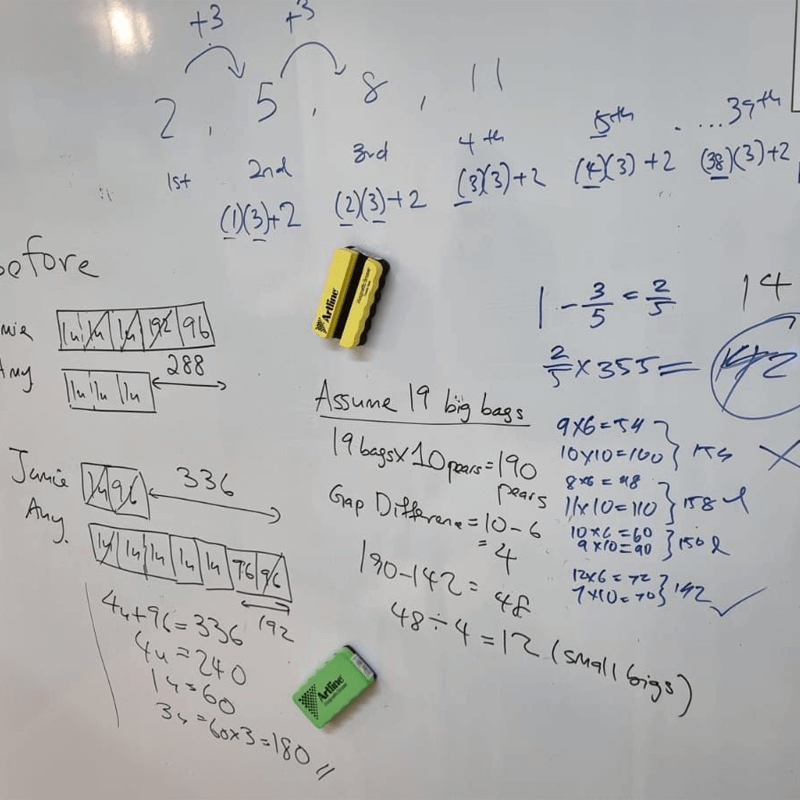
The bar model method is the most well-known element. It gives students a visual, relational way to represent word problems before any algebra or equations are written, making multi-step, multi-concept problems accessible to students at primary level. International school students who learn it typically say it changed their approach to problem-solving. It does not replace algebraic thinking; it prepares and supports it.
Beyond bar models, Singapore Math teaches problem-solving heuristics explicitly: a set of named strategies (Work Backwards, Make a List, Guess and Check, Unit Method) that students learn to select and apply based on the structure of the problem. This gives students a toolkit for non-routine problems, not just procedures for routine ones.
#1
Singapore ranked 1st in TIMSS primary mathematics. The rigour behind Singapore Math is internationally recognised
Bar Model
Singapore's signature visual problem-solving method, not taught in most international school curricula
≤5
students per class: every student's problem-solving process is observed and corrected, not just the final answer
How Ms Elaine Teaches Singapore Math to International Students
Adapted from Singapore curriculum methodology, structured for students who have not encountered it before.
Bar Model Method
Singapore's signature approach to word problems: representing quantities visually with bar diagrams before writing any equations. Once mastered, it makes multi-step word problems significantly more accessible and less error-prone.
Heuristics as a Problem-Solving Toolkit
Make a List, Work Backwards, Guess and Check, Unit Method, Draw a Diagram. Each heuristic is taught as a deliberate strategy. Students learn to identify which approach fits which problem type rather than attempting random methods.
Structured Word Problem Decoding
Many international school students read a complex word problem and do not know where to start. We teach a structured decoding sequence: identify given information, identify the unknown, choose the representation, build the model, solve and verify.
Number and Algebra Reasoning
Fractions, ratio, proportion, and algebraic thinking are developed through Singapore's concrete-pictorial-abstract sequence, building genuine understanding before moving to symbolic manipulation.
Programme Coverage
Bar Model Method
Part-whole, comparison, and before-and-after models for word problems at all levels of complexity
Fractions and Ratio
Singapore approach to fractions of a set, fraction of remainder, ratio word problems with model drawing
Percentage Problems
Percentage of quantity, percentage increase/decrease, reverse percentage: Singapore method
Rate, Speed, and Distance
Multi-step speed problems including average speed, overtaking problems, and relative speed
Algebra via Model Drawing
Transition from bar models to algebraic expressions, bridging visual and symbolic approaches
Area and Perimeter
Composite figures, overlapping areas, and problems combining geometry with algebra
Heuristics Training
Make a List, Guess and Check, Work Backwards, Supposition Method for non-routine problems
Exam Technique
How to present working in assessments, check answers systematically, and allocate time under exam conditions
Signs This Programme Is the Right Fit
These are the most common situations international school families bring to us.
Strong computation, weak word problems
Your child can calculate accurately but freezes when a problem requires multiple steps or when the structure is not obvious. This is a problem-solving strategy gap, not a math ability gap.
International curriculum does not teach Singapore methods
Bar models and Singapore-style heuristics are simply not part of most international school curricula. Without structured exposure, students miss a powerful problem-solving framework.
Preparing for a Singapore local school transition
Families moving to Singapore, or international school students considering a local secondary school, need to bridge the curriculum gap quickly. Singapore Math methods are tested throughout the local system.
Inconsistent performance on assessments
Good in class but unpredictable on tests: often a sign that understanding is procedural rather than conceptual. Singapore Math's structured approach builds the conceptual foundation that procedural fluency depends on.
Wanting academic rigour beyond the international school curriculum
Many parents find international school math insufficiently challenging. Singapore Math problem-solving provides the rigour and depth that develops mathematically strong thinkers.
What Parents Say About Ms Elaine
We are so grateful to have found Teacher Elaine. She is an incredibly patient and thorough math tutor who has made a huge difference in my son's learning. Her teaching style is clear and methodical, ensuring that my son fully understands each concept before moving on. We can see a significant boost in both his result and confidence.
Ellysa poh
Teacher Elaine is really a diamond amongst tuition teachers. She goes the extra mile to help my daughter when she had difficulty loving math due to her school's math teacher in P5 and teacher Elaine helped her to love the subject so much that she is now asking me to sign her up for year end math to learn more before school lessons. My daughter is now much more confident and does not delay doing her math homework. I am really deeply appreciative of all the hard work and support teacher Elaine has put in to change our lives.
Catherine Chan
Frequently Asked Questions
My child attends an international school. Why would Singapore Math be relevant?
Singapore Math is internationally recognised as one of the most rigorous primary mathematics curricula in the world. Its structured problem-solving approach, particularly the bar model method, gives students a visual, systematic way to tackle complex word problems that most international curricula do not teach explicitly. Many international school families choose to supplement with Singapore Math precisely because it develops stronger mathematical reasoning than their school curriculum alone.
Will this programme teach to the MOE Singapore syllabus or my child's school curriculum?
Neither exclusively. This programme teaches Singapore Math methods and problem-solving strategies as tools, not as a parallel curriculum. The goal is to develop your child's problem-solving ability, mathematical reasoning, and confidence: skills that transfer directly back to their own school's assessments and any international standardised tests.
What level is this programme pitched at?
The programme is flexible and can accommodate primary to lower secondary levels. Ms Elaine assesses each student at the first session to determine the right starting point. The pace and content are adjusted to the group, not a fixed syllabus. Message us to describe your child's current level and we can advise the right entry point.
My child is strong in math at school but weak at word problems. Is this the right programme?
Yes. This is one of the most common profiles among international school students. Strong computation skills combined with weak word problem performance almost always points to a gap in structured problem-solving strategy: knowing which approach to apply, how to represent the problem visually, and how to work systematically from given information to the unknown. These are exactly the skills this programme develops.
Explore Other Programmes
Build the Problem-Solving Skills Your School Does Not Teach
Message us to discuss your child's level and goals. We will recommend the right track and confirm current availability.