
Key Takeaways
- ✓MOE's 2024 syllabus changes moved Pie Charts and Nets from P6 to P4, and removed Speed entirely from primary — not all centres have updated their materials.
- ✓Under PSLE Achievement Level scoring, AL1 requires 90% and above. A score of 75% is now AL4, not a distinction.
- ✓Class size is the single most controllable quality factor. Five students or fewer lets a teacher catch errors in real time.
- ✓Book trial lessons at three or four centres in the same fortnight so you can compare teaching styles while impressions are fresh.
- ✓Ask about curriculum maps, not just testimonials. A centre that can show you how their term plan maps to MOE topics is ahead of most.
The question most parents start with — which centre has the best results? — is actually the wrong one. Results are lagging indicators and the data is easy to cherry-pick. What you want to know is whether a centre's teaching approach, class size, and curriculum materials are set up for your child specifically. Bukit Timah has no shortage of tuition options. Narrowing them down comes down to eight practical factors, and knowing exactly what to ask when you visit.
What Changed in 2024 That Every Parent Needs to Know
MOE began rolling out a revised primary math syllabus in 2021, starting with Primary 1. By 2024, the changes reached Primary 4. They will reach Primary 6 by 2026. The intent was to redistribute content more evenly across years, but the effect is that certain levels are now harder earlier.
| Topic | Old Level | New Level |
|---|---|---|
| Time (basic) | Primary 2 | Primary 1 |
| 12h and 24h Clock | Primary 4 | Primary 3 |
| Pie Charts | Primary 6 | Primary 4 |
| Nets | Primary 6 | Primary 4 |
| Average | Primary 5 | Primary 6 |
| Ratio | Primary 5 | Primary 6 |
| Speed | Primary 6 / PSLE | Removed from primary entirely |
| Turns and 8-Point Compass | Primary 4 | Removed from primary entirely |
The practical impact: a Primary 4 student today is expected to read and interpret pie charts — work that was previously left to Primary 6. Meanwhile, Speed has been moved out of the primary curriculum altogether and into Secondary 1. If a tuition centre is still drilling your P4 child on Speed, their materials have not been updated.
💡 Quick check when visiting a centre
Ask to see the P4 term plan. If Pie Charts and Nets are not covered before mid-year, the syllabus they are teaching is at least one revision behind.
How PSLE Achievement Levels Work
Singapore replaced T-scores with Achievement Levels in 2021. Each subject is graded AL1 to AL8 based on raw percentage score. Your child's PSLE aggregate is the sum of all four AL scores — lower is better, with 4 being the best possible.
| Achievement Level | Raw Score |
|---|---|
| AL1 | 90% and above |
| AL2 | 85% – 89% |
| AL3 | 80% – 84% |
| AL4 | 75% – 79% |
| AL5 | 65% – 74% |
| AL6 | 45% – 64% |
| AL7 | 20% – 44% |
| AL8 | Below 20% |
The bands at the top are deliberately narrow. A difference of five percentage points separates AL1 from AL2, and AL2 from AL3. At 75%, your child achieves AL4 — not a distinction grade. This is the part that surprises many parents who were used to the old system where a high-70s score still looked respectable. The upper bands reward consistent accuracy across paper types, which is why deep conceptual understanding matters more than drilling speed.
👩👧 What this means for tuition goals
If your child is currently at 70-75%, moving them to AL3 (80-84%) is achievable with targeted gap-filling. Moving them from AL3 to AL1 requires a different kind of work — harder problem types, fewer careless errors, and stronger checking habits. Make sure a centre can articulate how they address both.
The 8 Factors That Actually Predict a Good Fit
Score each centre out of 5 across these dimensions
8-Factor Tuition Evaluation Checklist
CPA Approach
1. Teaching Methodology
Concrete → Pictorial → Abstract — Singapore's standard progression
Max 5 students
2. Class Size
Allows real-time error correction; more than 8 and individual attention drops sharply
MOE experience preferred
3. Teacher Background
Familiarity with how concepts are taught in school prevents contradictory methods
2024 changes reflected
4. Syllabus Currency
Pie Charts in P4, Speed removed — verify against their actual term plan
Topic-level, not just grades
5. Progress Tracking
Monthly minimum; bi-weekly for P6
Real group session
6. Trial Lesson Quality
Not a one-on-one assessment — you want to see how they teach, not how they assess
Structured parent updates
7. Communication
Specific weaknesses identified, not just a grade report
Psychological safety
8. Classroom Atmosphere
Students should feel comfortable attempting problems and asking questions
1. Teaching Methodology
Singapore math follows a Concrete-Pictorial-Abstract (CPA) sequence — physical manipulatives first, then diagrams and model drawing, then abstract notation. This is not just a style preference; it is how MOE structures the school curriculum. A tuition centre that skips straight to abstract drill is working against what your child's school teacher is building.
The more useful question to ask is not "what method do you use?" but "how would you teach my child to approach a multi-step word problem they have never seen before?" A centre with a genuine methodology will walk you through the steps. One that cannot explain it beyond "we follow the syllabus" is telling you something.
2. Class Size
Five students per session is the ceiling for meaningful individual attention in a group format. At that size, a teacher can spot a wrong working method mid-problem and correct it before the habit sets. At twelve students, errors go unnoticed until marking. The class size claim is easy to verify — ask which session you could observe, and check whether it is actually running at the stated number.
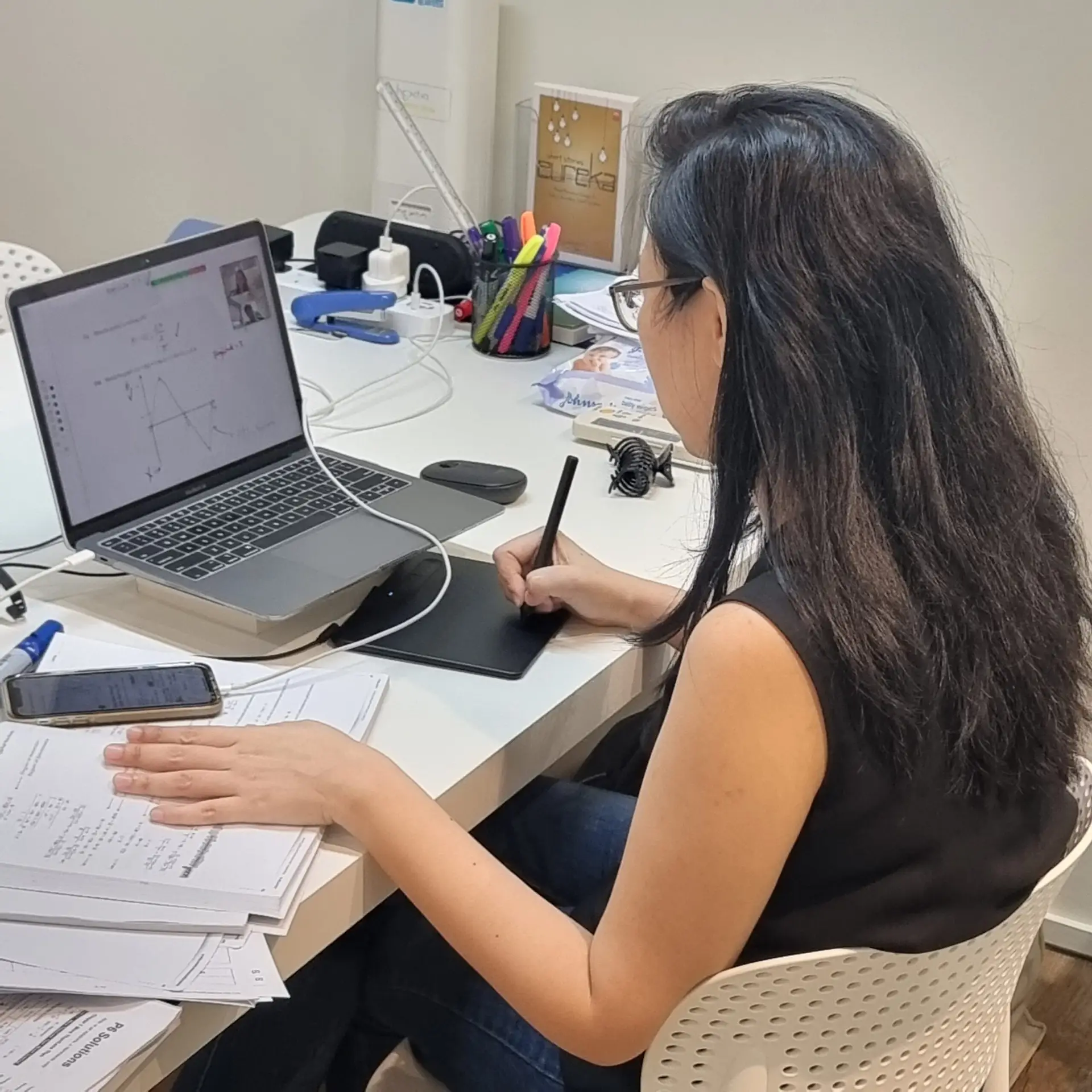
At MathArchery, sessions are capped at five students. Teacher Elaine, a former MOE teacher, runs all classes personally — there are no rotating tutors.
3. Teacher Qualifications and Continuity
MOE classroom experience is genuinely different from being a strong mathematician or having tutored many students. A teacher who has worked inside a Singapore primary school knows how topics are sequenced, how concepts are introduced, and where students typically get stuck at each level. That background reduces the risk of a tuition approach that inadvertently conflicts with school methods.
Teacher continuity matters just as much. Ask whether the same teacher will be with your child for the full year, or whether there is rotation. A child who rebuilds rapport with a new tutor every term loses time that should be spent on math.
4. Curriculum Alignment
Ask to see the term plan for your child's level. It should reflect the 2024 topic movements — see the table above or the full syllabus change breakdown here. If you are enrolling a P4 student and Pie Charts appear in Term 3 or 4, that is fine. If they do not appear at all, or if Speed is still being taught as a PSLE topic, the materials have not been updated.
5. Individual Progress Tracking
Grade averages tell you very little. What you want is topic-level feedback: which specific areas your child consistently gets right, where errors cluster, and what the teacher is doing about it. A monthly written update that names specific weaknesses is more useful than a verbal "he is doing better" at pickup.
6. Trial Lesson Quality
The trial should be a real session with the group your child would join, not a curated one-on-one assessment. You want to observe how the teacher handles a student who is confused, whether students feel comfortable raising hands, how pacing is managed across different ability levels. Sit in if the centre allows it. If they do not allow parent observation at any stage, that is worth noting.
7. Parent Communication
The information flow between a tuition teacher and a parent is often what catches a problem early enough to fix it. Ask how the centre communicates between sessions. A WhatsApp update after every lesson is not necessary, but a structured written report every two to four weeks is reasonable. For P6 students in Semester 2, bi-weekly is better.
8. Classroom Atmosphere
This one is harder to evaluate on a visit but important to watch for. A child who is afraid of being wrong in front of peers stops attempting harder problems. The questions worth observing: do students ask questions unprompted, do they attempt problems they are unsure about, does the teacher respond to mistakes by exploring them rather than simply correcting them? Confidence and accuracy tend to develop together when the environment is right.
Questions to Ask During a Trial Lesson
- 1.Can you walk me through how you would teach a child to approach a multi-step word problem they have not seen before? — A structured answer tells you there is a method. A vague answer tells you there is not.
- 2.What specific topics does your P4 (or P5/P6) curriculum cover this term, and how does it align with the 2024 MOE changes? — This is the fastest way to check whether their materials are current.
- 3.How do you communicate progress to parents between sessions? — Listen for specifics: topic names, frequency, format.
- 4.What would you do if my child is stuck on the same concept for three consecutive sessions? — Centres with real pedagogy have an answer. A shrug or "we would do more practice" is not one.
- 5.How many students are in the session my child would join, and is that consistent across the year? — Confirm the headcount is not just the advertised number for trials.
- 6.Does the same teacher take all sessions, or is there rotation? — Relevant for continuity.
- 7.Can I observe a session before committing? — Some centres do not allow this. Know what you are enrolling into.
Red Flags Worth Walking Away From
- →Guaranteed grade improvements. No legitimate centre guarantees specific AL outcomes. Learning depends on the student, not just the teacher.
- →Curriculum materials that have not been updated since 2021. Speed as a PSLE topic, Pie Charts listed under P6 — these are concrete signs the content is stale.
- →Inability to show a term plan or curriculum map. If a centre cannot tell you what they are teaching and in what sequence, there is no structured programme.
- →Pressure to commit to a full year upfront without a trial period. Quality centres do not need to lock in reluctant families.
- →Marketing built entirely around top student results. Consistent improvement across a range of students matters more than a handful of AL1 outliers.
- →High teacher turnover. Ask how long the current teaching staff have been there. Frequent changes suggest something about working conditions that will affect your child too.
A Practical Timeline for Making the Decision
Start three months before you actually need support. Leaving it to the week your child brings home a failing test paper means choosing under pressure.
- →Week 1: Shortlist four to five centres based on location, class size claims, and whether they mention the 2024 syllabus changes anywhere on their site.
- →Weeks 2-3: Book trial lessons at your top three or four choices. Schedule them within the same fortnight so you can compare with a fresh memory of each.
- →Week 4: Evaluate using the eight factors above. Weight class size and syllabus currency heavily — these are the factors most likely to have a direct impact on your child's experience. Give your child a voice in the decision too; if they disliked the trial, find out why before overriding the preference.
- →Months 1-3: Treat the first term as a continued evaluation. A good centre will show observable changes in your child's confidence and ability to attempt unfamiliar problems, not just small incremental score gains.
📝 About MathArchery
MathArchery runs small-group sessions of up to five students in Bukit Timah, taught by Teacher Elaine — a former MOE teacher with primary school classroom experience. Classes are structured around the current MOE syllabus including the 2024 topic changes, with regular written updates to parents on topic-level progress.
If you are currently evaluating options, you are welcome to book a trial session at MathArchery or check available class schedules. Trial lessons run as real group sessions so you can see exactly how classes work before committing.
Sources & References
- [1] MOE PSLE Scoring System. Official MOE page on Achievement Level thresholds for all PSLE subjects.
- [2] MOE Primary Math Syllabus. MOE curriculum page for primary mathematics.
- [3] Primary Math Syllabus Changes — Keynote Learning. Summary of topic movements across levels under the revised primary math syllabus.
- [4] New Changes to MOE Primary Maths Syllabus — The Learning Lab. Detailed breakdown of syllabus changes by level with implementation timeline.