
Secondary 1 Math Tuition
in Bukit Timah
Classes for G1, G2, G3 and IP students at King Albert Park, Bukit Timah, with online and hybrid options available.
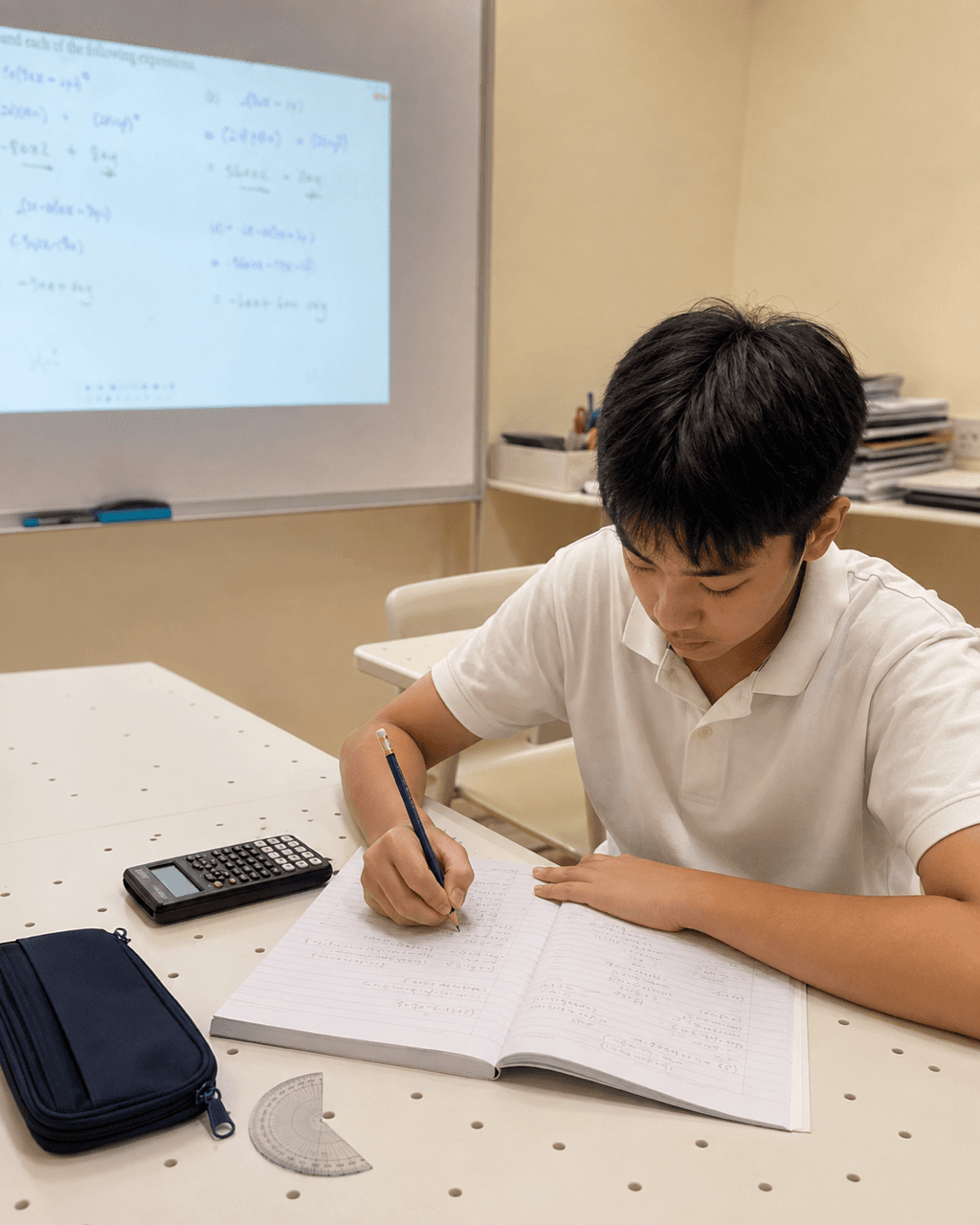
What changes in Secondary 1 maths?
The first Secondary 1 test often comes back lower than anything your child scored in Primary 6.
If that has just happened in your house, you are not looking at a child who has suddenly become worse at maths. You are looking at a subject that changed shape over one December holiday, and a child who was never told.
Hello parents and students. In Primary 6 your child solved problems with numbers, bar models and a good heuristic. In Secondary 1 the numbers become letters. The syllabus opens with primes, negative numbers and significant figures, then moves straight into algebraic expressions, linear equations and graphs of y = ax + b. Angles and polygons come back with formal reasons attached, and mensuration adds prisms and cylinders.
None of this is beyond a child who did well at PSLE. What catches them is that the methods change. A student who leaned on shortcuts to get through problem sums now has to say what x stands for, and why the two sides of an equation stay equal. I have watched confident P6 students go quiet in Term 1 because the ground moved and nobody named it. Naming it is the first thing I do. The second is more interesting.
Signs your Secondary 1 child could use a hand
These show up in the exercise book before they show up in a test. Any two of them, and the next section is for you.
Algebra feels like a foreign language
They can compute 3 × 5 but freeze at 3y, or they add 2x and 3 to get 5x.
Negative numbers keep flipping
Subtracting a negative, ordering numbers on a line, and signs in equations are a daily source of lost marks.
The working has gone missing
Answers appear with no lines between them, and the marks for method go with them.
Ratio and percentage came back harder
Reverse percentages and rates such as km/h to m/s trip up students who thought they had finished with these topics.
Confidence dipped after the first test
A child who liked maths in primary school now says they are "not a maths person". That sentence is the one I most want to hear early, because it is the easiest to reverse.
They are doing fine and want more
Some students find Secondary 1 slow. They deserve harder problems and a teacher who notices.
How I teach Secondary 1 at MathArchery
Four things I do in every Secondary 1 lesson, and why each one works.
Why before how
Before a single rule, we look at what a letter is doing in an expression and why an equation balances. Students who can explain a method keep it; students who memorise it lose it by the next test.
From concrete to abstract
The same Concrete, Pictorial, Abstract path I use in primary school carries into algebra: a bar model becomes an equation, a table of values becomes a graph. Your child arrives with the pictures already in their head. I use them.
Accuracy, Speed, Consistency
Short Mathercises every week build the fluency that secondary school assumes: signs, fractions, expansion, factorising. Ten minutes of this beats an hour of re-explaining.
Both kinds of learner
I hold a Specialist Diploma in Specific Learning Differences and I have taught high-ability students through IP and IB. Some need a slower start; some need a harder question. A small group is what lets me give both.
What does Secondary 1 maths cover?
Secondary One content from the MOE G2/G3 Mathematics syllabus, which G1 students meet in a lighter form. We follow your child's school scheme of work, so topics arrive in the order their teacher teaches them.
Numbers
Primes and prime factorisation, HCF and LCM, negative numbers and integers, rational and real numbers, approximation and significant figures
Ratio, percentage, rate
Ratios with rational numbers, reverse percentages, average speed and unit conversion
Algebra
Letters for numbers, evaluating expressions and formulae, the nth term of a pattern, simplifying linear expressions, factorising with common factors
Functions and graphs
Cartesian coordinates, linear functions y = ax + b, gradient
Equations
Linear equations in one variable, simple fractional equations, forming an equation from a word problem
Geometry
Angle properties, parallel lines, triangles, special quadrilaterals and regular polygons, constructions
Mensuration
Area of parallelogram and trapezium, volume and surface area of prisms and cylinders
In person, online or hybrid
Secondary students can join in person at our studio, online, or a mix of the two. Older students handle online lessons well, and a hybrid arrangement means a busy week or a bout of flu does not cost your child a lesson.
In person, we are at MathArchery, 9 King Albert Park #02-22, KAP Mall, about 10 minutes' sheltered walk from King Albert Park MRT (DT6), with basement parking and a 10-minute grace for drop-off.

About Your Coach
I'm Elaine Goh, Teacher Elaine to my students. I have taught Primary, Secondary, IP and IB Mathematics for over eight years, and I hold a Specialist Diploma in Specific Learning Differences. If your child is willing to learn and work alongside me, and puts in the effort, any challenge in secondary maths can be overcome. The foundation we build now is what upper secondary maths will rest on, so it matters that we build it well.
More about meWhat parents say about learning with Teacher Elaine
Teacher Elaine is really a diamond amongst tuition teachers. She goes the extra mile to help my daughter when she had difficulty loving math due to her school's math teacher in P5 and teacher Elaine helped her to love the subject so much that she is now asking me to sign her up for year end math to learn more before school lessons. My daughter is now much more confident and does not delay doing her math homework.
Catherine Chan, Google Review
From a child who detests Math to one who looks forward to her weekly math lessons… without any nagging on my part.
Unis S, Google Review
Questions parents ask
Do you take G1, G2, G3 and IP students?
Yes. Each class follows one stream, so the pace and the depth of the questions match what your child's school expects, and go a little beyond it.
My child did well at PSLE. Do they need this?
Not every child does. If Term 1 algebra is going smoothly, keep going. If the first test came back lower than expected, or the working has disappeared from their answers, a weekly class fixes habits before they set.
My child struggled in primary school. Will they be out of their depth?
No. I teach from the point of weakness, in small steps, and a small class lets me do that without anyone waiting. Developing students and top performers both belong here.
Do you follow my child's school?
Yes. Bring the scheme of work and the latest test. We work in the order their school teaches and use their school's notation.
Is there a trial lesson?
Yes. Message me and we will find a slot that suits you. Class times and fees are on the schedule page.
What about the December bridging workshops?
Those are for P6 students moving up. This is the weekly class once your child is in Secondary 1.
Moving up from P6 this December? See the bridging programme. Why the first two secondary years matter: read the article.
Explore other levels
Tell me about your child
Share with me what has happened to your child in Secondary 1, and anything you have noticed. We can arrange a trial lesson so I can understand your child better.