
Secondary 2 Math Tuition
in Bukit Timah
Classes for G1, G2, G3 and IP students at King Albert Park, Bukit Timah, with online and hybrid options available.
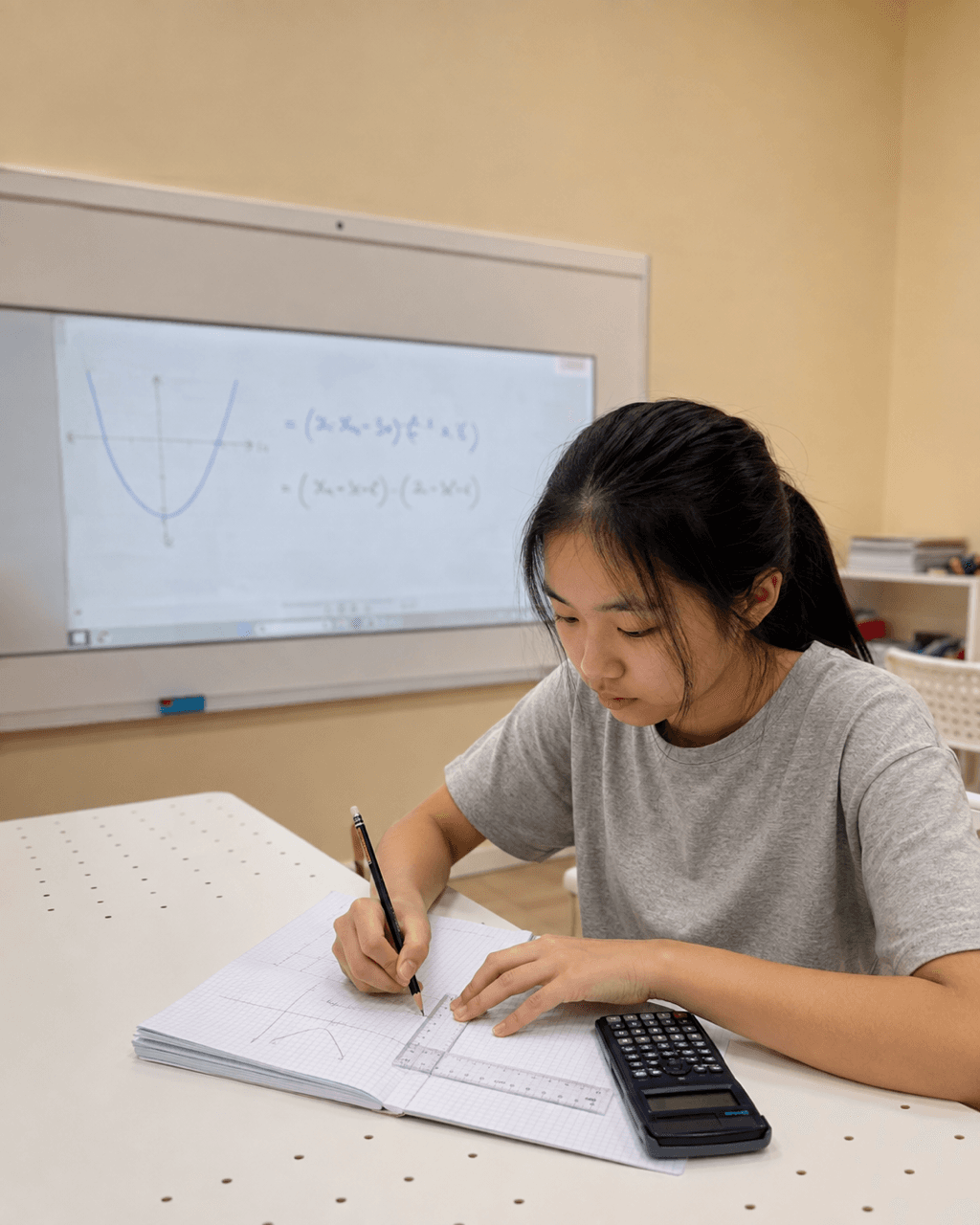
What changes in Secondary 2 maths?
Secondary 2 is the year algebra stops being a topic and becomes the language everything else is written in.
Hello parents and students. In Secondary 1 your child learned what a letter stands for. In Secondary 2 they are asked to take expressions apart and put them back together: expanding products, factorising quadratics, adding fractions with algebra in the denominator, changing the subject of a formula. Then the same algebra turns up inside geometry, as Pythagoras and trigonometry, and inside graphs, as the parabola.
It is also the year the school looks at results and decides the subject level for Secondary 3. I mention that not to add pressure but because it is the reason Secondary 2 marks feel heavier than Secondary 1 marks did, and because the topics that decide them are few and specific.
A student who memorised Secondary 1 gets found out here. A student who understood it finds Secondary 2 surprisingly natural. My work is to move a child from the first group to the second, one idea at a time, and the next section is where I usually see the difference first.
Signs your Secondary 2 child could use a hand
These show up in the exercise book before they show up in a test. Any two of them, and the next section is for you.
Expansion goes fine, factorising does not
They can open (x + 3)(x + 2) but stare at x² + 5x + 6. The reverse direction needs a different kind of thinking, and it is the one Secondary 3 leans on.
Algebraic fractions feel like a trap
Adding 1/(x − 2) and 2/(x − 3) looks like arithmetic and behaves nothing like it. Marks disappear in the denominators.
Simultaneous equations are solved by guessing
They find the answer once and cannot say why, so the next pair with awkward coefficients defeats them.
Trigonometry arrived and nobody explained why
SOH CAH TOA is memorised as a chant. Which ratio to use in a real triangle is the part that is never clear.
Confidence has quietly slipped
Secondary 2 is the year many students decide, silently, what kind of maths student they are. That decision is reversible, and this is the year to reverse it.
They are coping and want to go further
A student who finds Secondary 2 comfortable should be meeting harder problems now, before the Secondary 3 workload arrives.
How I teach Secondary 2 at MathArchery
Four things I do in every Secondary 2 lesson, and why each one works.
Why before how
Before a single rule, we look at why (a + b)² is not a² + b², with a square drawn on the page. Students who can explain a method keep it; students who memorise it lose it by the next test.
From picture to symbol
The same Concrete, Pictorial, Abstract path I use in primary school carries into quadratics and trigonometry: a drawn parabola before the formula, a labelled triangle before the ratio. Your child arrives with the pictures already in their head. I use them.
Accuracy, Speed, Consistency
Short Mathercises every week build the fluency Secondary 3 assumes: expansion, factorising, sign work, rearranging formulae. Ten minutes of this beats an hour of re-explaining.
Both kinds of learner
I hold a Specialist Diploma in Specific Learning Differences and I have taught high-ability students through IP and IB. Some need a slower start; some need a harder question. A small group is what lets me give both.
What does Secondary 2 maths cover?
Secondary Two content from the MOE G2/G3 Mathematics syllabus, which G1 students meet in a lighter form. We follow your child's school scheme of work, so topics arrive in the order their teacher teaches them.
Algebra
Expansion of products, the three identities, factorising linear and quadratic expressions, changing the subject of a formula, algebraic fractions
Functions and graphs
Quadratic functions y = ax² + bx + c, their graphs, turning points and symmetry
Equations and inequalities
Simple inequalities on a number line, simultaneous linear equations by substitution, elimination and graph, quadratic equations by factorisation
Ratio and proportion
Map scales for distance and area, direct and inverse proportion
Congruence and similarity
Congruent and similar figures, properties of similar triangles, enlargement and reduction
Pythagoras and trigonometry
Pythagoras theorem, testing for right angles, sine, cosine and tangent in right-angled triangles
Mensuration
Volume and surface area of pyramid, cone and sphere
Statistics and probability
Dot diagrams, histograms, stem-and-leaf; mean, median and mode; probability of single events
In person, online or hybrid
Secondary students can join in person at our studio, online, or a mix of the two. Older students handle online lessons well, and a hybrid arrangement means a busy week or a bout of flu does not cost your child a lesson.
In person, we are at MathArchery, 9 King Albert Park #02-22, KAP Mall, about 10 minutes' sheltered walk from King Albert Park MRT (DT6), with basement parking and a 10-minute grace for drop-off.

About Your Coach
I'm Elaine Goh, Teacher Elaine to my students. I have taught Primary, Secondary, IP and IB Mathematics for over eight years, and I hold a Specialist Diploma in Specific Learning Differences. If your child is willing to learn and work alongside me, and puts in the effort, any challenge in secondary maths can be overcome. The foundation we build now is what upper secondary maths will rest on, so it matters that we build it well.
More about meWhat parents say about learning with Teacher Elaine
Teacher Elaine is really a diamond amongst tuition teachers. She goes the extra mile to help my daughter when she had difficulty loving math due to her school's math teacher in P5 and teacher Elaine helped her to love the subject so much that she is now asking me to sign her up for year end math to learn more before school lessons. My daughter is now much more confident and does not delay doing her math homework.
Catherine Chan, Google Review
From a child who detests Math to one who looks forward to her weekly math lessons… without any nagging on my part.
Unis S, Google Review
Questions parents ask
Do you take G1, G2, G3 and IP students?
Yes. Each class follows one stream, so the pace and the depth of the questions match what your child's school expects, and go a little beyond it.
Secondary 2 results decide next year's subject level. Can a weekly class make a difference in time?
Often, yes, if we start early in the year. The topics that decide Secondary 2 marks are few and specific: factorising, algebraic fractions, simultaneous equations, trigonometry. Fixing how a student thinks about those four changes the whole year.
My child struggled in Secondary 1. Is it too late?
No. Secondary 2 revisits every Secondary 1 idea in a harder form, which means every gap gets a second chance to close. I teach from the point of weakness, in small steps, and a small class lets me do that without anyone waiting.
Do you follow my child's school?
Yes. Bring the scheme of work and the latest test. We work in the order their school teaches and use their school's notation.
Is there a trial lesson?
Yes. Message me and we will find a slot that suits you. Class times and fees are on the schedule page.
Can my child join online?
Yes. Secondary classes run in person, online or hybrid, and older students handle online lessons well.
Looking for the Secondary 1 class? Why the first two secondary years matter: read the article.
Explore other levels
Tell me about your child
Share with me how Secondary 2 has gone for your child so far, and anything you have noticed. We can arrange a trial lesson so I can understand your child better.